The Retkee app, with you on the go — rated



 Martin & Tina
•
08. 07. 2026
Martin & Tina
•
08. 07. 2026
When we were planning our first trip abroad with our daughter, we wanted somewhere where we wouldn’t be caught off guard by the language, the distance, or the healthcare system, just in case. At the same time, we wanted a place where you can actually go out, not just sit by a resort pool. Austria came up as our first choice, and after a few days in the Hallstatt / Dachstein area, we know it was a good one.
In this article, we summarize why Austria works as a first international destination with a baby, where we stayed, what trips we managed with our three-month-old daughter, and what we found useful to have in our suitcase.
Why Austria for your first trip
There are several reasons why Austria suited us, and they are worth naming:
- Distance. From most of the Czech Republic, you can be in the Austrian Alps in 3–5 hours by car. You can manage the journey with stops for breastfeeding and diaper changes even with a small baby without it becoming a marathon. We drove from Prague and with one stop, we were there in five hours.
- Facilities and services. Austrian shops are well-stocked, pharmacies are accessible, changing tables work at rest areas, and Rossmann or DM are exactly as you know them from the Czech Republic. If you run out of diapers or porridge, you aren’t reliant on the lottery of a local convenience store.
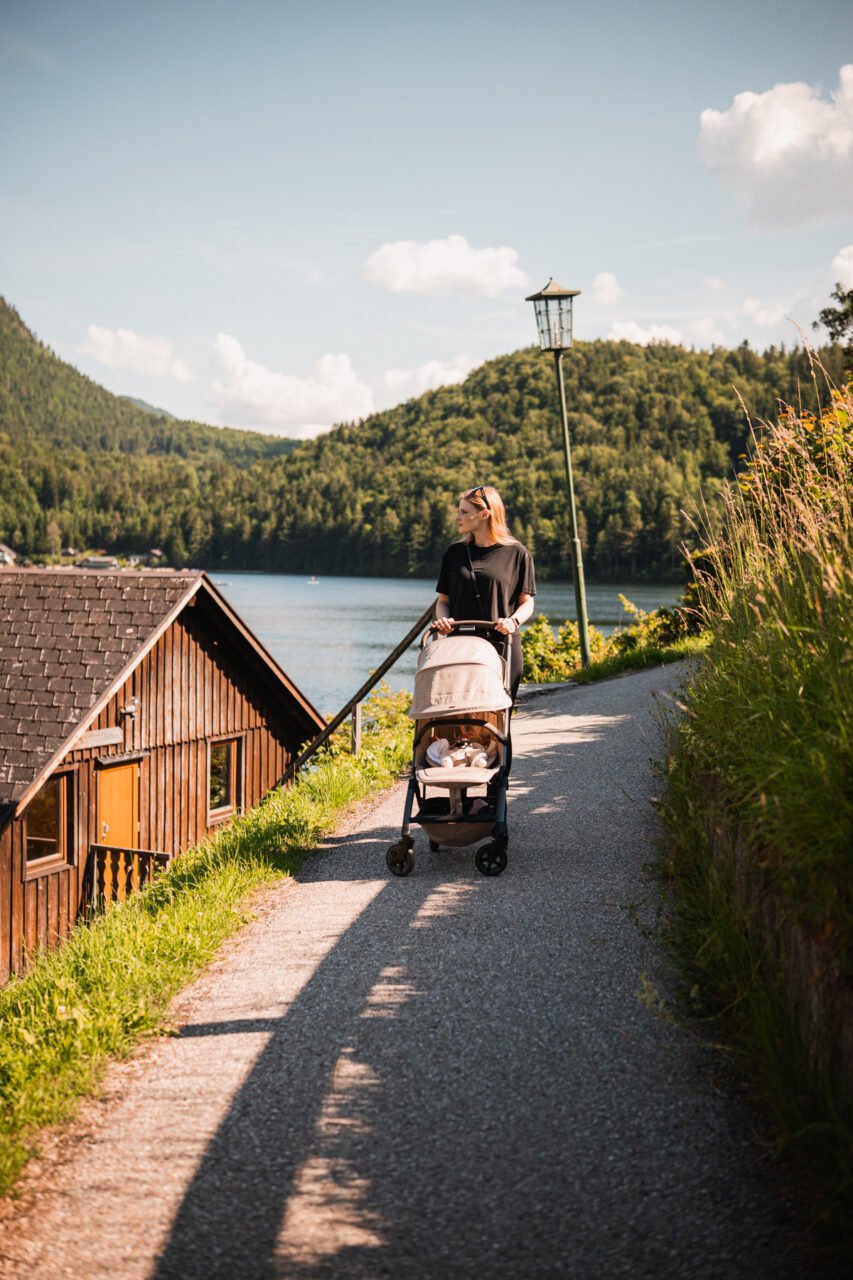
- Nature accessible with a stroller. This was probably the biggest positive surprise. Surprisingly, the Austrian Alps are very stroller-friendly – a stroller is no problem at most cable cars, the promenades around the lakes are paved, and even some mountain trails can be managed with a non-terrain stroller. But more on that in the section about trips.
- Healthcare. Austria has a functional system, and in tourist areas, they speak English in the doctors’ offices.
Practical note on documents: Since this year, even a baby needs their own travel document (ID card or passport) for a trip to Austria. We recommend arranging it well in advance of the trip; issuance can take several weeks.
Where we stayed
For our first trip with a baby, we set one main criterion: an apartment, not a hotel. The reason is purely practical. In an apartment, you have a kitchenette with a microwave for heating food and sterilizing pacifiers, a proper fridge for supplies, and above all, space where a crib can be set up and parents can eat in peace or have a coffee when the child (by chance :)) is sleeping.
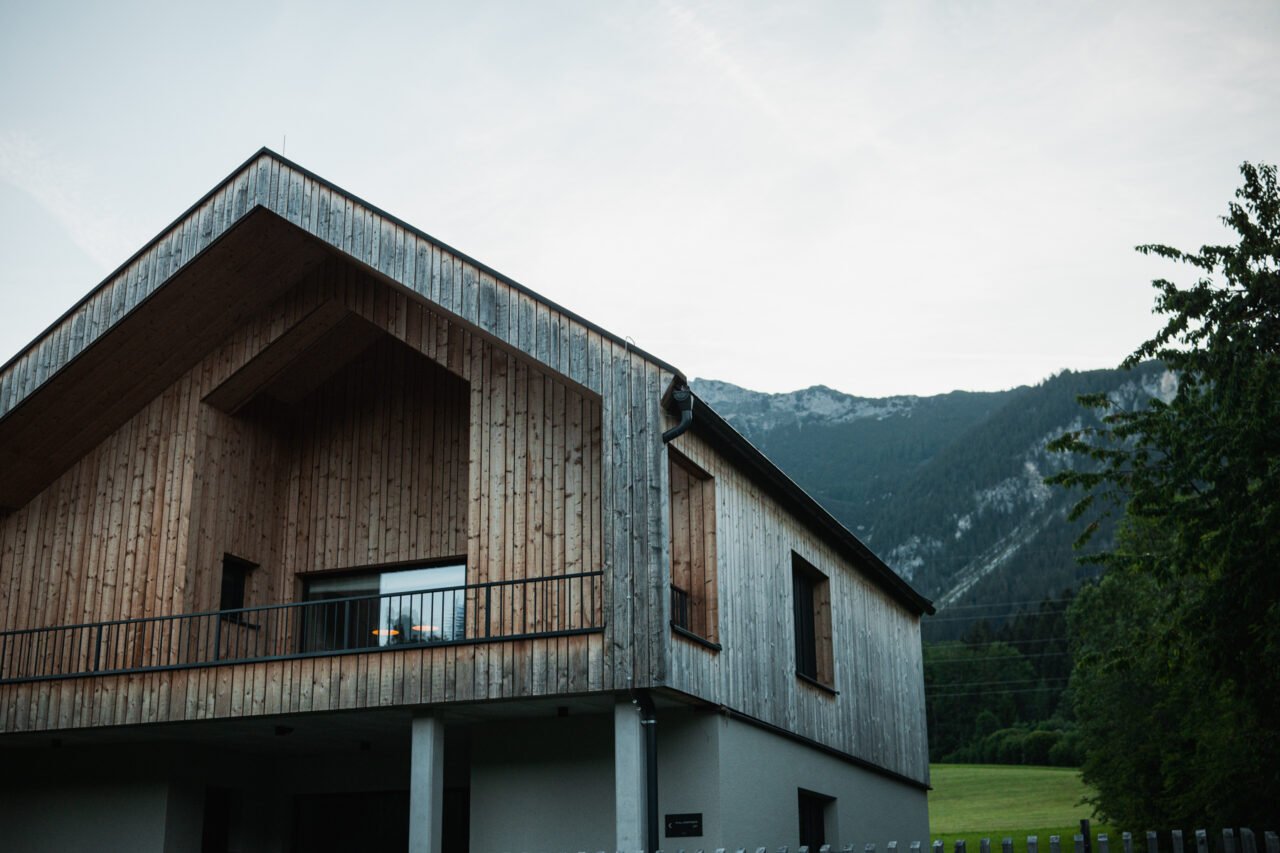
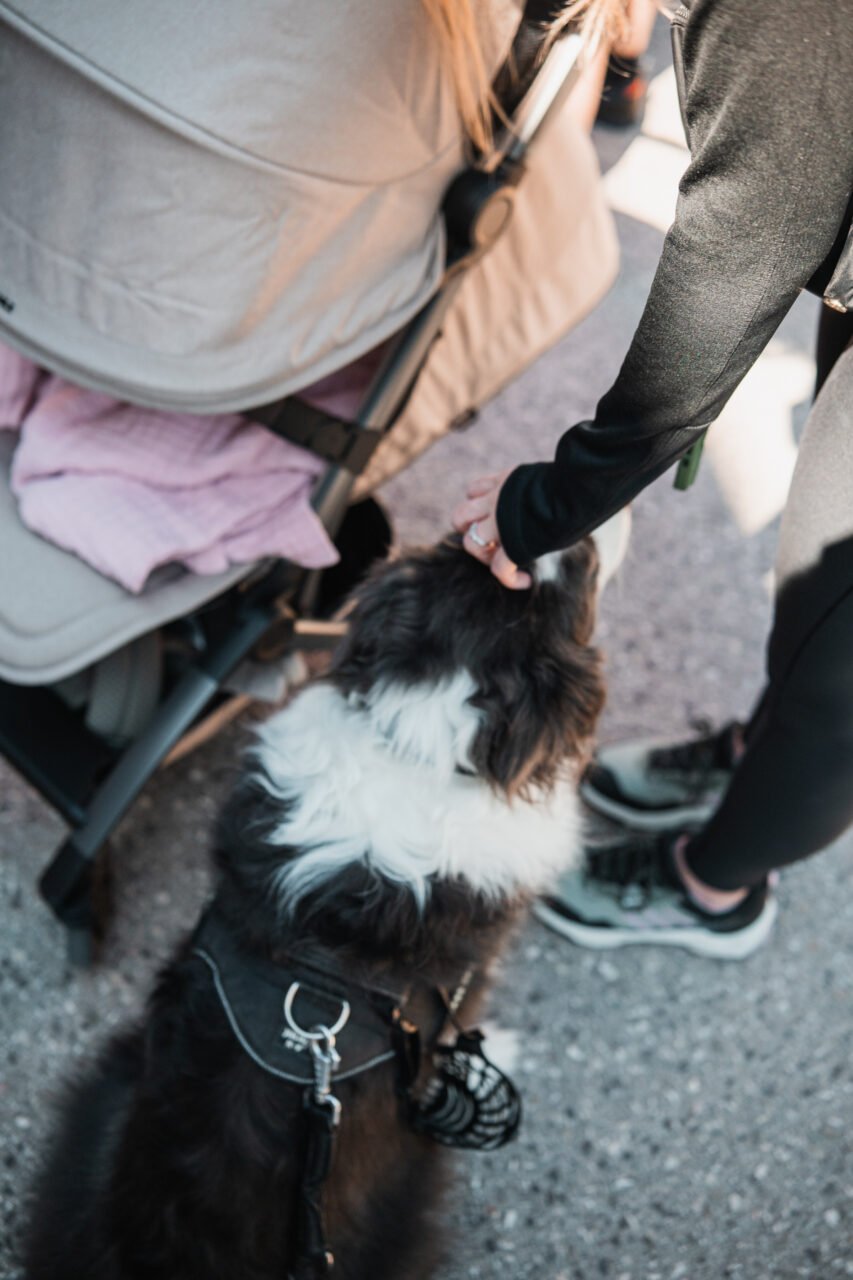
We chose Da Alois, about 40 minutes from Hallstatt, modern apartments with a garden, a wellness area, and an ideal location for trips around the area. We can definitely recommend Da Alois apartments, also because of the bike path that is right in front of the accommodation and leads for several kilometers around the area – so it’s also ideal for walks with a stroller. For us, the advantage was also a small garden, because our “first, four-legged” child came with us too.
If you want to compare more options around Hallstatt, explore the offers on Booking.com.
A few tips for staying with a baby in general
Regardless of which destination you eventually choose, a few things are worth checking before booking:
- Crib on site. Most apartments and hotels in Austria provide one for free on request, but ask in advance. If not, you can bring a portable crib with you.
- Kitchenette equipment. Microwave, electric kettle, stove, and fridge with freezer. This is the minimum that saves a lot of nerves.
- Ground floor or elevator. Especially if you are traveling with a very small baby and the stroller stays folded in the hallway, you don’t want to deal with stairs.
- Quiet. Try to find out in advance if the accommodation is noisy; you don’t want to be woken up, and neither does the baby.
Trips we managed with the baby
The pace is different than without a child, there’s no need to debate that. Instead of four trips a day, we did one or two, with plenty of time for diaper changes and breastfeeding, as well as afternoon rest. But what we did manage was a great mix of nature and mountain atmosphere.
Krippenstein and the 5 Fingers viewing platform
The Krippenstein cable car runs from Obertraun, a ten-minute drive from Hallstatt. A stroller fits easily into the spacious cabins, and the staff is helpful. We planned to go up with our daughter in a carrier, but in the end, it turned out that the path to the 5 Fingers viewpoint is paved and we made it even with a travel stroller. If you have an all-terrain stroller, all the better for you.
5 Fingers
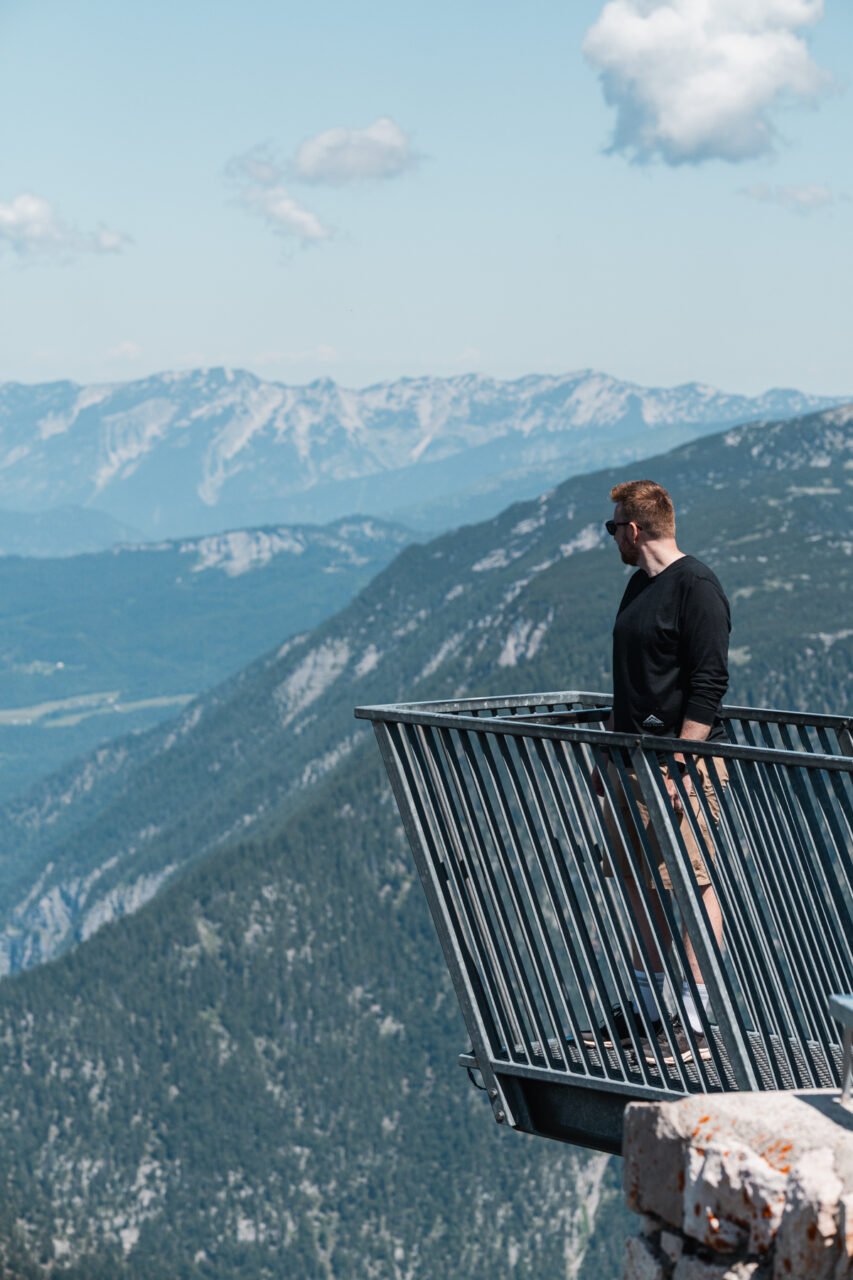
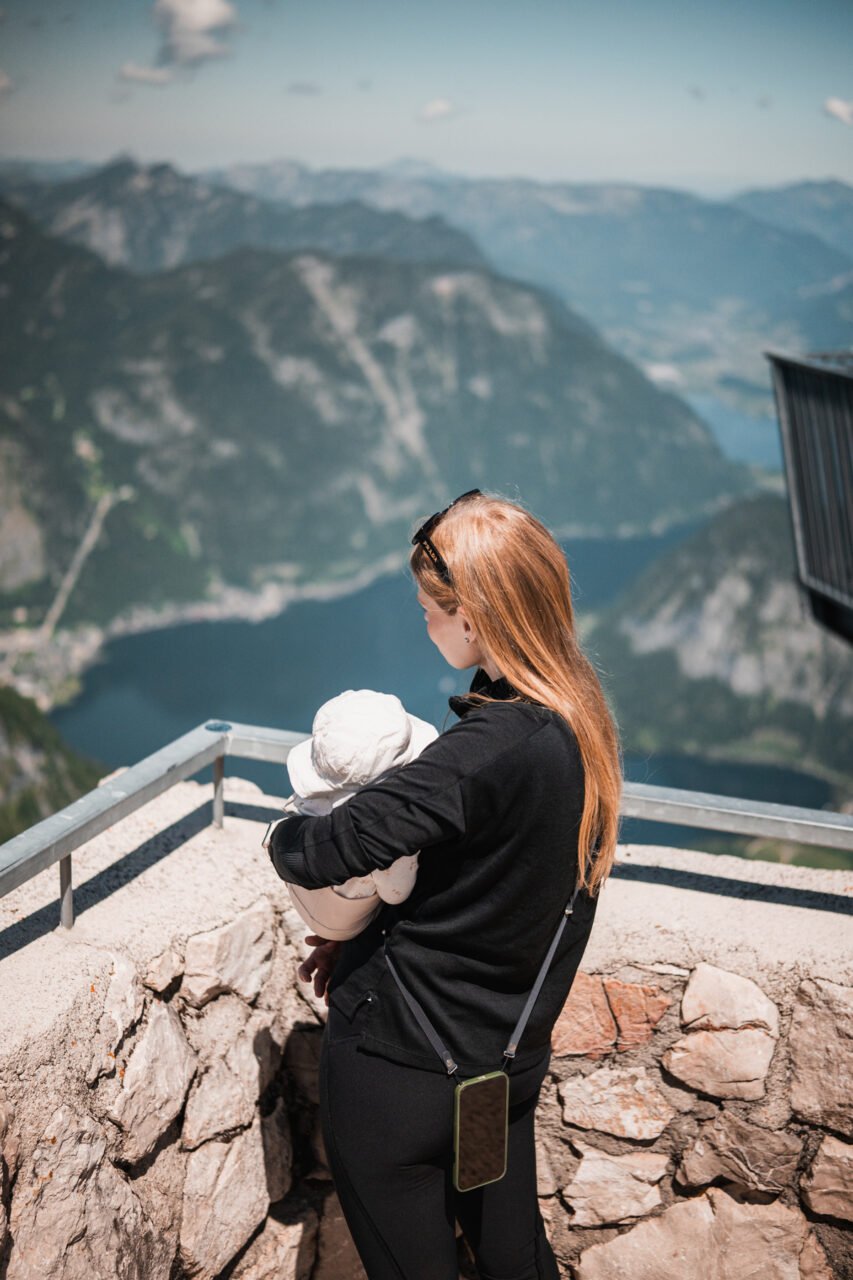
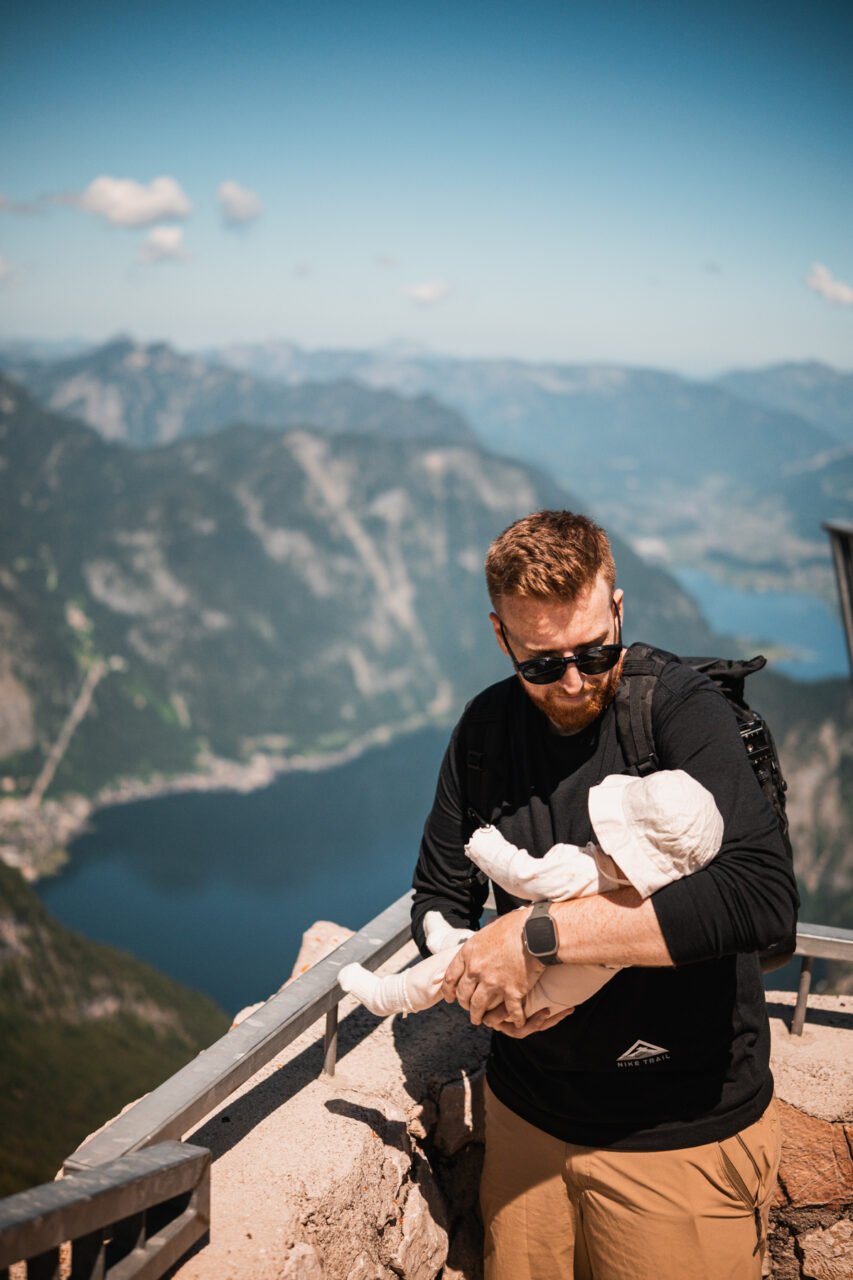
The 5 Fingers viewing platform is one of the most famous spots above Hallstatt. It stands on the summit of Krippenstein at an altitude of around 2,100 meters and, shaped like a hand with five fingers, it extends over a precipice roughly 400 meters deep. It opened in October 2006, and the main highlight isn’t the journey there, but the platform itself — directly below you lie Hallstatt, its lake, and the surrounding peaks of the Dachstein massif.
The easiest way to reach the viewpoint is by taking the cable car to Krippenstein. From the top station, it’s a 15 to 30-minute walk, mostly on asphalt, so almost anyone can handle the route, even with a stroller. Along the way, views of the Dachstein glacier and surrounding peaks open up, so it’s never boring even before you reach your destination. There are five platforms (as the name suggests) and each is different: each finger measures about 4 meters, one has a glass floor, another features a large Baroque frame for your photos of Hallstatt, and one resembles a diving board. Entry to the viewpoint itself is free; you only pay for the cable car, without which you practically can’t get up there.
Keep in mind that you’ll be walking slightly downhill to the viewpoint, so the way back to the cable car is uphill and may take a bit more time — make sure to leave a buffer for your return trip, as they run roughly every 15 minutes during the season. If you have time, feel free to stretch your trip to Krippenstein into a full day and combine it with other spots at the summit and nearby, such as the Welterbespirale viewpoint, the ice cave, or the shark statue. Additionally, the cable car and platforms only operate during business hours, so check the schedule in advance.
Show the detail
The viewpoint itself is an experience – a steel structure over a precipice from which you can see down to Hallstättersee. We were there around eleven in the morning and had it almost to ourselves. According to the staff, queues form during the day. And even though the cable car isn’t the cheapest thing, it takes you to truly beautiful views where you can easily spend half a day. And there’s no problem with a stroller here.
Lakes in the area – Grundlsee, Toplitzsee, Hallstättersee
If cable cars with a baby stress you out, the lakes are a perfect alternative. A paved promenade leads around Grundlsee, which you can reach a few meters from the parking lot. Toplitzsee is quieter; you can get to it with a short walk through the forest, and from April to October, a historic steam boat runs there (children under two for free, a stroller fits on board).
Toplitzsee
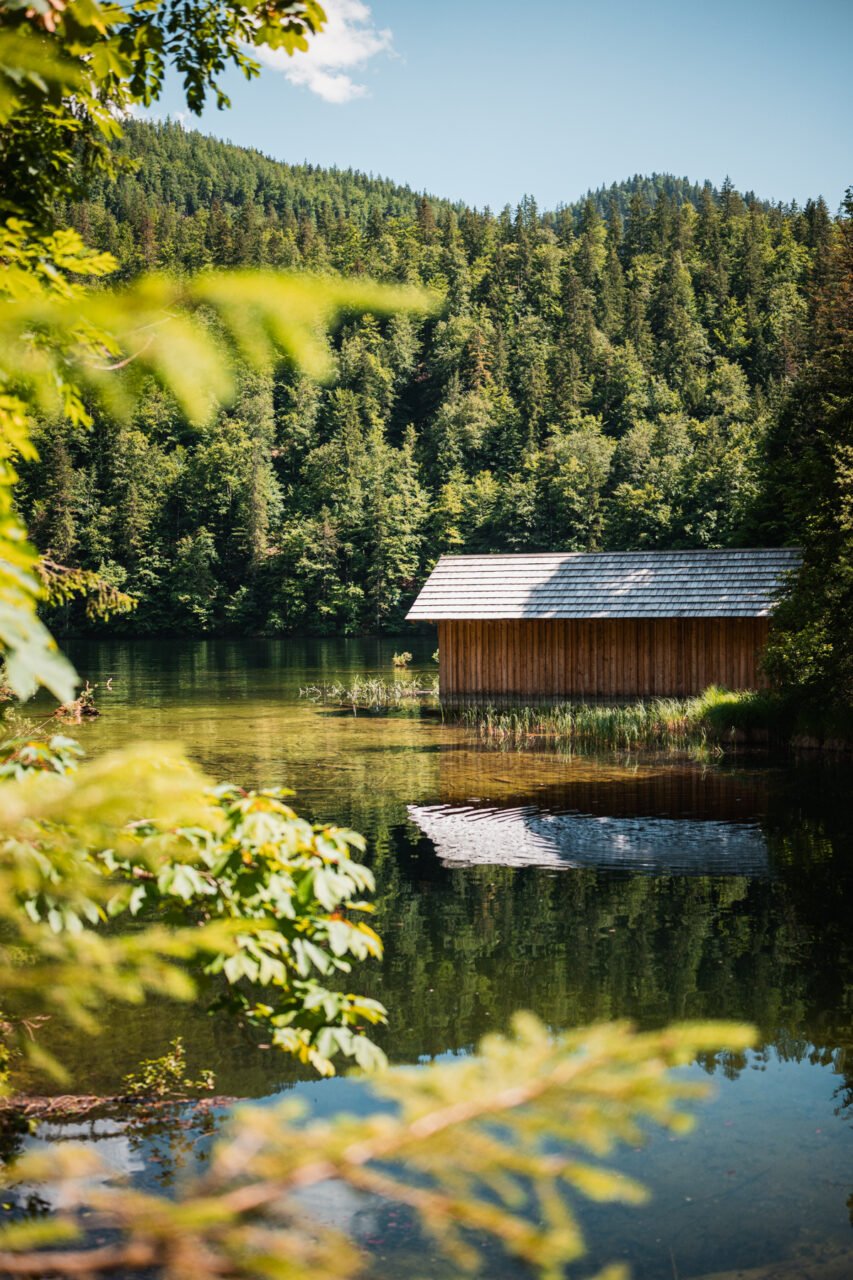
Toplitzsee is the smaller and much quieter neighbor of Grundlsee, located just to the east. It lies in a nature reserve at an altitude of 718 meters, measuring only about 2 kilometers, but it’s over 100 meters deep – for comparison, the much larger Grundlsee is “only” 64 meters deep. You’ll notice the main difference right away: you can’t get here by car. You park in Gössl at the end of Grundlsee and walk, or arrive by boat. Plus, there’s no circular path around the lake and it lacks the facilities you’re used to at Grundlsee.
The path from Gössl leads through the forest along a stream and is pleasantly cool in the summer. It’s easy and you can manage it even with a stroller. Our photo tip is the shore by the small wooden dam, where a cabin stands right on the water. It’s also a nice spot for a snack and a break before you head back or further on.
Toplitzsee is mainly known for its history, though. During World War II, the German army tested weapons here, and towards the end of the war, the Nazis sank crates here, which included counterfeit British pounds. The legend of hidden treasure still attracts divers and searchers today, even though repeated searches of the lake bed haven’t yielded any major finds.
Show the detail
Hallstatt with its famous view of the town is a logical number one, but be prepared for crowds. We recommend either early morning (before nine) or late afternoon (after five) when the tour buses leave. In the middle of the day, you simply won’t be able to get through the narrow streets of Hallstatt with a stroller and you’ll lose your nerves in the process.
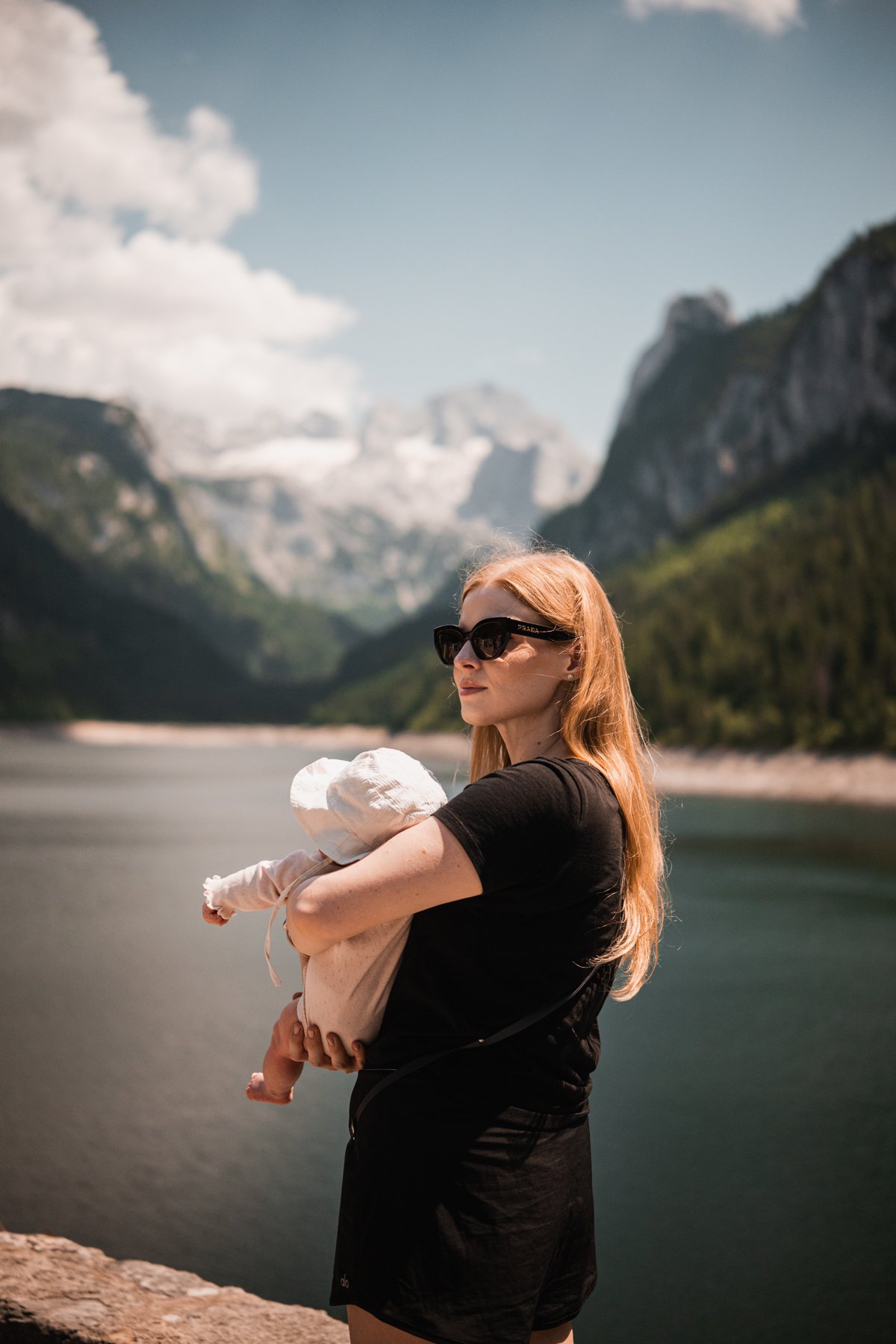
Gosausee – a beautiful trail and views
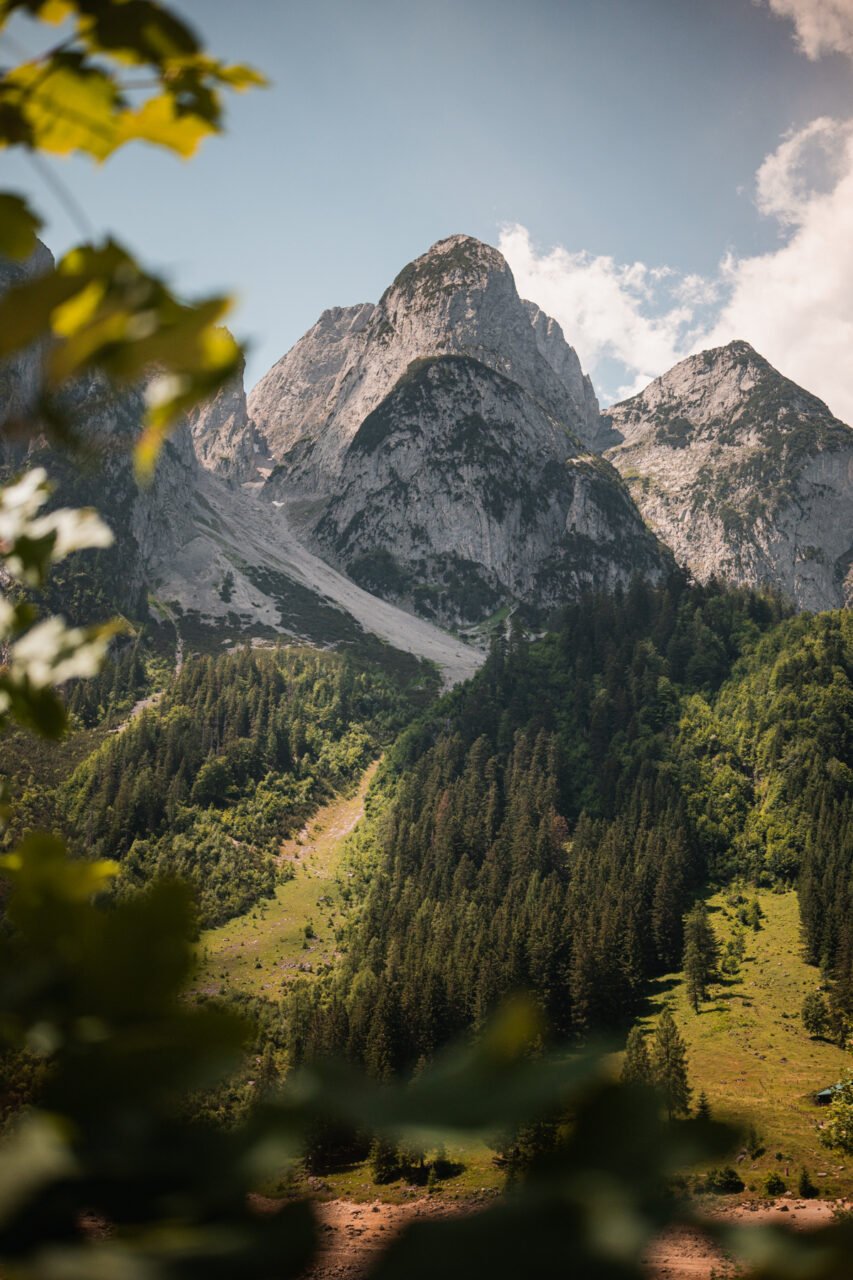
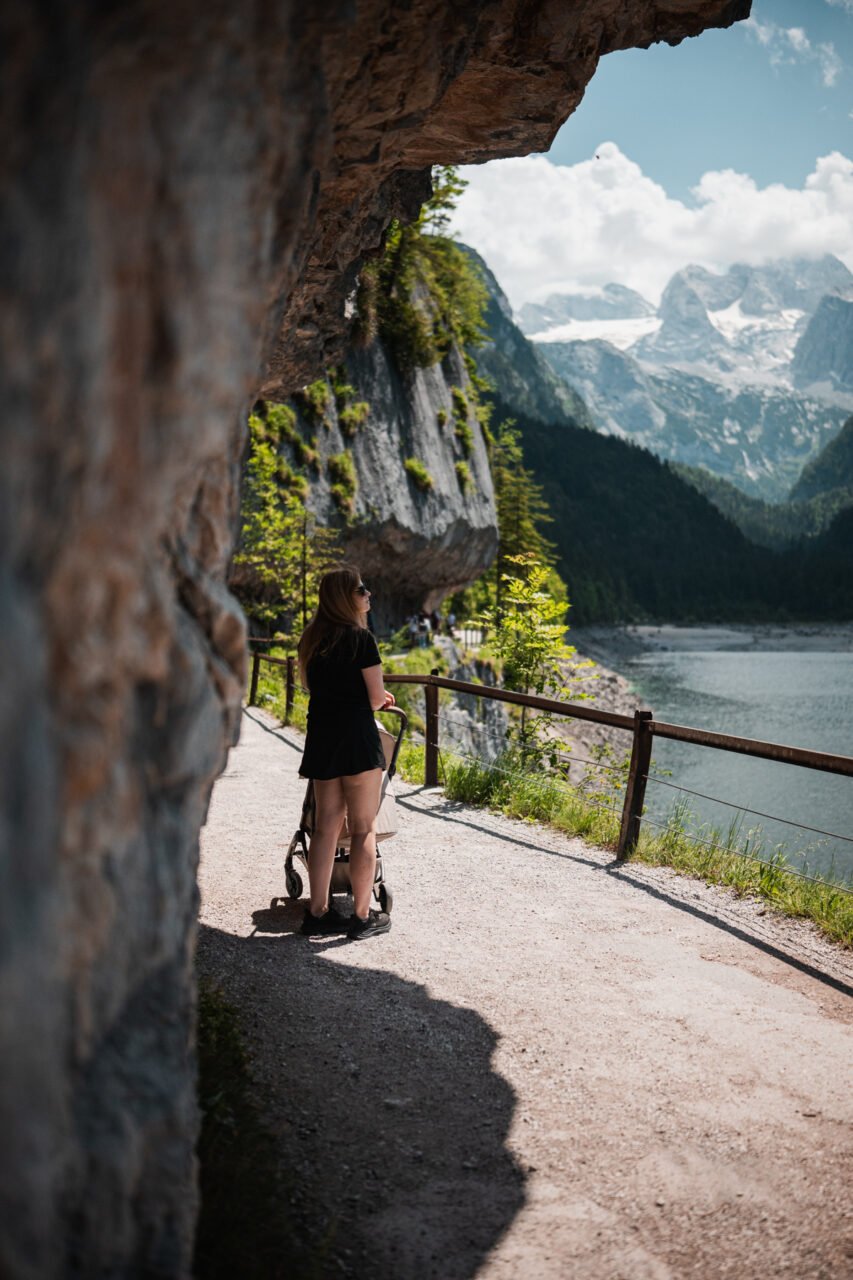
Another place we simply must recommend and managed with a stroller and a dog is Lake Gosausee. Specifically the first one, which you can drive to and where the trail starts. This place simply enchanted us; we won’t soon forget the view of the Dachstein glacier and the surrounding peaks. We carried the stroller twice along the way; in one place there was more water and in another there was a cattle barrier, but again, nothing terrible.
What we didn’t do and you might want to
We didn’t manage everything at that time with our three-month-old daughter – for example, we didn’t even try more demanding mountain trails or the Dachstein ice cave. If you have an older toddler or a preschooler, they would probably manage both activities and they are worth considering. You can find more detailed tips in our guide to the Austrian Alps.
What to pack extra compared to a normal trip
A few things that might come in handy on a trip with a baby:
- Travel or all-terrain stroller. We managed perfectly fine with the Joolz Aer2 travel stroller; we left the big Cybex at home and didn’t miss it. You might also find a sunshade or, conversely, a rain cover for the stroller useful.
- Travel bottle warmer for the car (12V). An underrated helper if you aren’t 100% breastfeeding.
- Enough diapers and baby food for the first two days. So you don’t have to deal with shopping right away before you find out where the nearest DM, Rossmann, or Spar is.
- Medications you use at home. Paracetamol for babies, eye drops, something for fever. They will give them to you in an Austrian pharmacy, but it’s definitely better to be prepared.
- A wrap or ergonomic carrier. When the stroller can’t pass, the carrier always will.
- A bouncer or lounger. If you have space in the car and your child likes being in a bouncer or lounger, you’ll appreciate having your hands free at the accommodation. If your child is older, you’ll also use it for feeding.
Austria with a baby: it’s possible and it’s worth it
The first trip abroad with a baby is always a bit of a leap into the unknown, but Austria showed us that you don’t have to be afraid of anything major. A short trip, good facilities, lots of nature accessible even with a stroller, and peace of mind knowing that in case of anything, you have a functional system behind you.
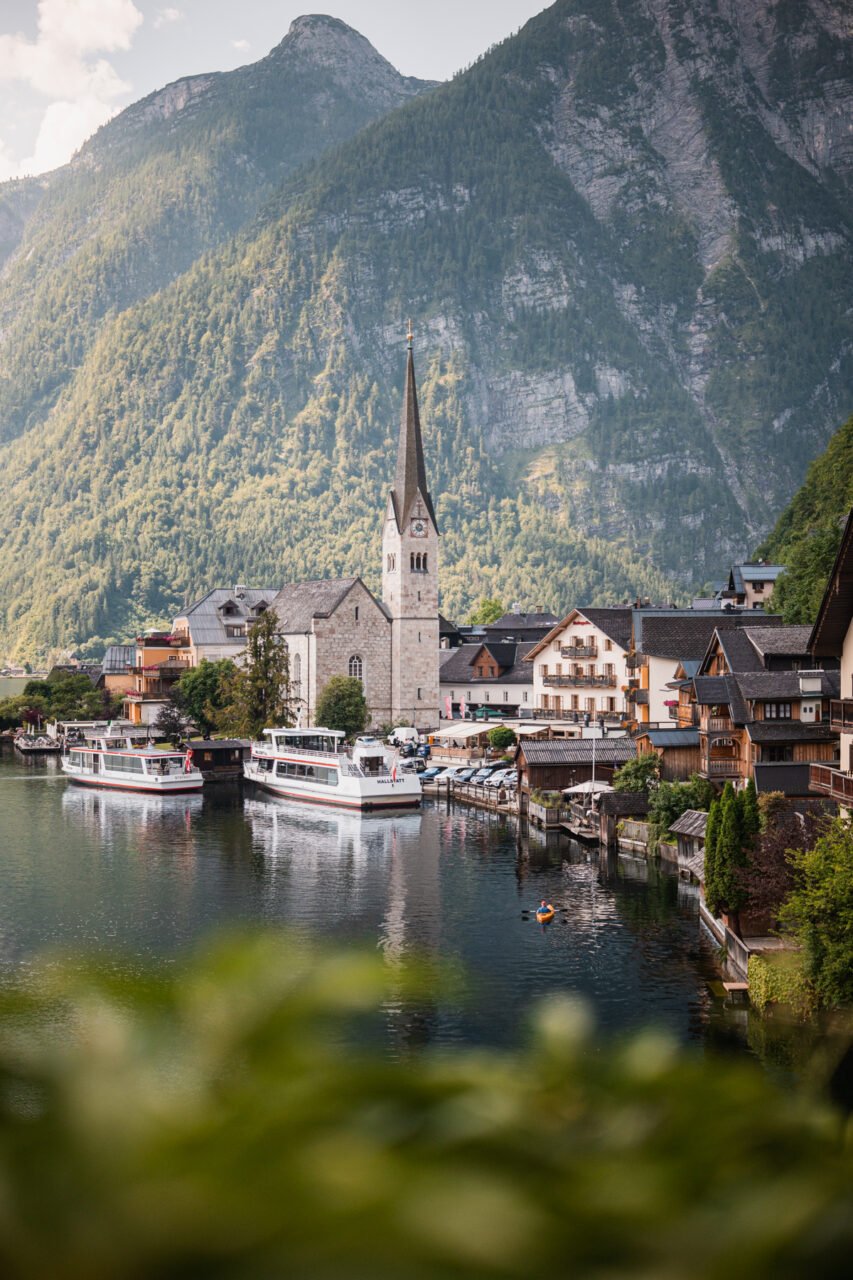
Austrian Alps: a guide from Salzburg to Tyrol
Show guide
You can also find all the mentioned tips and dozens of others in our complete guide to the Austrian Alps. It contains specific itineraries, verified places, and tips for routes that can be managed both with a baby and with a running child.
This guide and dozens of others with Retkee+
Get unlimited access to premium content, maps, and discounts. No commitment, cancel anytime. Now also available in our mobile app.